
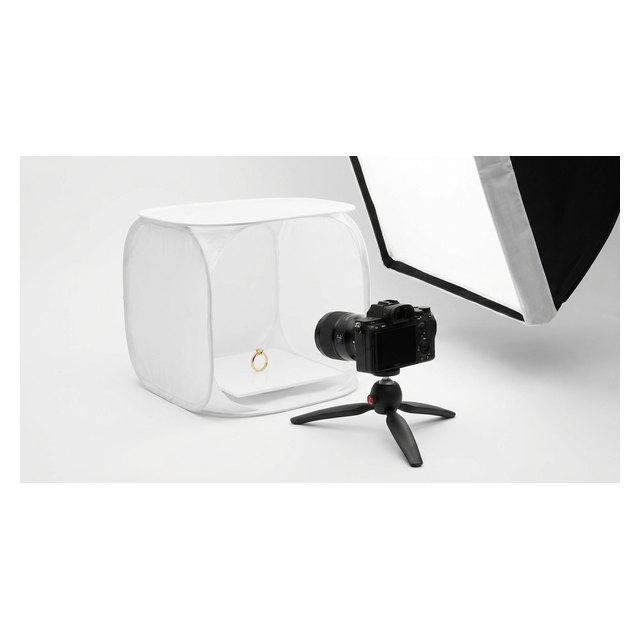
Online, your photographs are the product. A well-made piece shot badly reads as a badly made piece, and the habits that fix this are simple enough for any maker to apply.
Light first
Jewellery is small, reflective and often faceted — three properties that punish bad light. Diffused, consistent light from two directions kills hard reflections on polished metal; a single hard light creates blown highlights that hide the very surfaces you polished. Daylight from a window with a thin white curtain is an honest starting setup; light tents and LED panels make it repeatable.
Focus and stability
At macro distances the depth of field is millimetres thin. Use a tripod or a brace, focus manually on the stone or the focal detail, and stop down for a little more depth. One perfectly sharp photo of the key detail outperforms ten soft overall shots.
Backgrounds, scale and honesty
Clean neutral backgrounds make colour and sparkle legible; a hand, wrist or neckline adds scale and desire. Shoot the same set of angles every time — front, side, on-body, detail, packaging — so your catalogue looks intentional and returns drop. Show flaws honestly in at least one frame: online buyers return what arrives as a surprise.
Going further
Lighting for metals and gems, styling and workflow are taught in the digital jewellery photography course at JDMIS — built for jewellers, not photographers — and the marketing side of using the images sits in the jewellery business curriculum at JDMIS.
Frequently asked questions
What lighting works best for photographing jewellery?
Diffused, consistent light from two directions. Jewellery is small, reflective and often faceted, so a single hard light creates blown highlights; diffused light from both sides kills hard reflections on polished metal. A window with a thin white curtain is an honest starting setup.
Why use a tripod for jewellery photography?
At macro distances the depth of field is only millimetres thin. A tripod or brace plus manual focus on the stone or focal detail delivers one perfectly sharp photo of the key detail, which outperforms ten soft overall shots.
What angles should I shoot for an online jewellery catalogue?
The same set every time - front, side, on-body, detail and packaging - so the catalogue looks intentional. Show at least one frame with the flaw visible: online buyers return what arrives as a surprise.