
The JDMIS is committed to providing students with a quality educational experience supported by clear academic, administrative, and student protection policies. I am pleased to make the following declaration in respect of the School's core policies and operating practices.
Student-Teacher Ratio and Teaching Staff
For online synchronous theory classes, the School maintains a maximum student-teacher ratio of 36:1. For practical or studio-based training components, the School maintains a maximum student-teacher ratio of 12:1 in order to support closer supervision, skills development, and individual guidance. The School maintains a combination of full-time and part-time teaching staff to support the delivery of its programmes.
Classrooms and Facilities
The JDMIS maintains specialised training facilities equipped to support its jewellery design, fabrication, gemmological, and digital design programmes. These facilities include, where relevant to the course offered, computers, projection and visualisation systems, microscopes, gemmological testing equipment, and specialised jewellery tools such as laser welder, a hydraulic press, plating and polishing equipment, wax injector, high-temperature kiln, magnetic finishing tools, flex-shaft rotary finishers, rolling mills, work benches and other tools required for training and supervised practical work. The School's facilities are maintained to support the effective delivery of its approved courses and learning activities. The Gem Vault 28sqm and the Sapphire room is 29sqm in size.
Instructors and Governing Boards
The JDMIS maintains an Academic Board to review academic quality, curriculum matters, and policies related to teaching and learning. The Academic Board comprises Mrs. Tanja Manuela Sadow, Mr. Bhavik Bhatt, and Mr. Alex Zupancich. The School also maintains an Examinations Board responsible for oversight of policies and procedures relating to assessments and examinations. The Examinations Board comprises Mrs. Tanja Manuela Sadow, Mr. Alex Zupancich, and Mr. Bhavik Bhatt.
The School's instructors are selected on the basis of their academic, professional, and/or industry experience relevant to the subjects they teach. All instructors teach part-time (With school managers also including administrative functions in their full-time work. Refer to individual course schedules for the instructor leading that run and to their individual profiles in the Academic Leadership page for their areas of specialisation and interest.
JDMIS regular, Singapore-based instructors include:
Mr. Alexander Zupancich (post-graduate degree in business administration, ACTA)
Mr. Robert Schilling (degree, jewellery diplomas, ACLP)
Mr. Wahab Hussain (diplomas in jewellery specialisations)
Mrs. Sujata Rai Chowdhury (degree, jewellery diplomas, ACLP)
Mrs. Michelle Wong (post graduate doctorate degree, jewellery diploma, ACLP)
Mr. Tameem Mohammmed (degree, jewellery skills certifications, ACLP)
Mrs. Cherry Tan (degree, jewellery diploma, ACLP)
Mrs. Sharon Tan (post-graduate degree in business, jewellery diploma, ACLP)
Organizational Structure
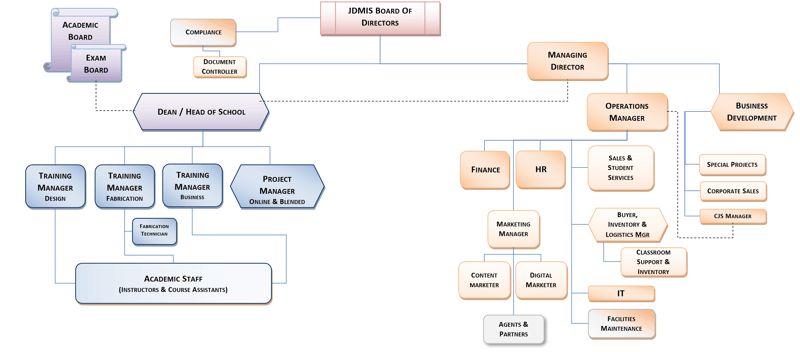
The JDMIS is a small and specialized school; run by experienced and capable entrepreneurs who understand the key to the school's success is the operation of an efficient, student focussed and quality driven enterprise. While formally, the school maintains a series of distinct roles within the organization, in practice the school managers and team members fulfil many of these roles simultaneously, and more efficiently than with large numbers of departments and staff. Students are likely to interact with JDMIS registration and student services staff on a regular basis, but otherwise operational and management issues will be raised to either Tanja Sadow or the Managing Director, Alex Zupancich. The school also maintains inventory, maintenance, accounts, design and marketing related staff on full, part-time or outsourced bases. The school's board of directors (ie: overall managers of the school) may be found here.
Transparent Pricing and Refund Policies
The JDMIS maintains policies and procedures aimed at ensuring its staff and agents represent the courses we offer clearly and accurately. All marketing documentation clearly states pricing information and JDMIS course prices are inclusive of required tools and materials, mean students will never find themselves having to pay more to complete the supervised project work that is part of the JDMIS curriculum and take with them the tools they need to continue practicing the skills they have learned (please note however that students are free to supplement these materials for self-study projects completed outside of Diploma contact training hours). The JDMIS is a GST registered company and all fees paid to the JDMIS are subject to the prevailing Singapore Goods and Service Tax. Qualifying tourists may request a GST refund for the tools and materials provided as part of the course.
The JDMIS is aware that circumstances may arise that make it impossible for a student to complete their course of study. When these circumstances affect the JDMIS ability to offer a scheduled course, the school will always offer a refund to its affected students. Where students withdraw from our programmes for personal reasons, the JDMIS is willing to offer full or partial refunds according to clearly stated notice requirements.
Established Feedback Channels and Grievance Redress Policies
The JDMIS recognizes that there are always opportunities for improvement and maintains an open feedback channel by means of its student services staff and electronic communications channels which are attended directly by staff and reviewed periodically by management. In instances of misunderstandings or disputes between students, with faculty or against the school itself the JDMIS follows a clear grievance resolution process that includes external mediation and arbitration as a last resort.
Standard Student Contract for Diploma Courses
All prospective local and international students participating in JDMIS full-time diploma programs are required to enter into the Standard Student Contract before course admission. Sample of this Standard Student Contract can be viewed at Council for Private Education's website or you may request a copy of this contract from the School. A copy of the relevant contract is included in the admissions documentation sent to all students accepted into JDMIS Diploma programmes. Student completing short courses or individual short modules that make up a larger programme are requested to complete contracts if on their confirmation of intent to register of a diploma (by means of commitment to specific fixed course schedules leading to a diploma.) For most modular participants this intent is manifested with their final module course registration.
Available Diploma Courses
JDMIS offers the following diploma and advanced diploma programmes, which are open to eligible participants subject to the applicable admission requirements:
Diploma in Fine Jewellery Design (Enhanced)
Consists of the following Diploma Modules (Some also available as individual stackable certifications):
- JD100 Classical Jewellery Design 1: Creative Drawing & Essential Jewellery Knowledge
- JD200 Classical Jewellery Design 2: Technical Drawing and Counter sketching
- DD100 Digital Jewellery Design 1: Fundamentals of Digital Jewellery Design (CAD)
- DD200 Digital Jewellery Design 2: Intermediate 3D Modelling & Gem Settings
- GT100 - Trade Practices 1: Gem & Jewellery Trade Secrets
- FT100 Fashion Trends 1: Epic & Contemporary Trends
- (Optional for Enhanced Diploma: Enhanced Project Module: Bespoke Jewellery Design)
- (Optional for Enhanced Diploma: Enhanced Project Module: Complete Jewellery Line Design)
Diploma in Precious Metal Arts (Enhanced)
Consists of the following Diploma Modules (Some also available as individual stackable certifications):
- MS100 Traditional Metalsmithing 1: Foundation Metalwork Skills & Experience
- MS200 Traditional Metalsmithing 2: Intermediate Techniques & Basic Stone Setting
- NM100 New Metal Technologies 1: New MetalsCreative Silver Modelling Techniques
- NM200 New Metal Technologies 2: Sculptural Design with Mixed Media
- GT100 - Trade Practices 1: Gem & Jewellery Trade Secrets
- FT100 Fashion Trends 1: Epic & Contemporary Trends
- (Optional for Enhanced Diploma: Enhanced Project Module: Bespoke Fashion Jewellery)
- (Optional for Enhanced Diploma: Enhanced Project Module: Fashion Show Jewellery Set)
Diploma in Fashion Jewellery Arts (Enhanced)
Consists of the following Diploma Modules (Some also available as individual stackable certifications):
- FJ100 Fashion Jewellery Arts 1: Creative & Essential Fashion Jewellery Knowledge
- FJ200 Fashion Jewellery Arts 2: Intricate & Versatile Fashion Jewellery Styles to Impress
- FJ300 Fashion Jewellery Arts 3: Efficiency & Effectiveness for Fashion Jewellery Design Sales
- FJ400 Fashion Jewellery Arts 4: Master Fashion Jewellery Techniques
- GT100 - Trade Practices 1: Gem & Jewellery Trade Secrets
- FT100 Fashion Trends 1: Epic & Contemporary Trends
- (Optional for Enhanced Diploma: Enhanced Project Module: Bespoke Fashion Jewellery)
- (Optional for Enhanced Diploma: Enhanced Project Module: Fashion Show Jewellery Set)
Advanced Diploma in Fine Jewellery Design (Enhanced)
Consists of the following Diploma Modules (Some also available as individual stackable certifications):
- JD300 Classical Jewellery Design 3: Jewellery Illustration, Light & Colour
- JD400 Classical Jewellery Design 4: Presentation & Layout of Jewellery Designs
- DD300 Digital Jewellery Design 3: Advanced 3D Modelling & Production
- DD400 Digital Jewellery Design 4: Jewellery Modelling with non-Jewellery Tools
- GT200 Trade Practices 2: Gem Identification Methods
- FT200 Fashion Trends 2: Aesthetic Self Discovery & Future Trends
- (Optional for Enhanced Diploma: Enhanced Project Module: Gem and Jewellery Redesign)
- (Optional for Enhanced Diploma: Enhanced Project Module: Jewellery Competition Submission)
Advanced Diploma in Precious Metal Arts (Enhanced)
Consists of the following Diploma Modules (Some also available as individual stackable certifications):
- MS300 Traditional Metalsmithing 3: Metalsmithing with Intermediate Stone Setting
- MS400 Traditional Metalsmithing 4: Casting Metals & Advanced Stone Setting
- NM300 New Metal Technologies 3: Advanced Techniques with Moulds to Gold
- NM400 New Metal Technologies 4: Professional Powder Metallurgy Masterclass
- GT200 Trade Practices 2: Gem Identification Methods
- FT200 Fashion Trends 2: Aesthetic Self Discovery & Future Trends
- (Optional for Enhanced Diploma: Enhanced Project Module: Replicate Lost Heirloom Jewellery)
- (Optional for Enhanced Diploma: Enhanced Project Module: Manufacture Jewellery From Provided Wax)
Other short courses that are not included within the JDMIS Diploma Curriculum may include:
- ME100 Jewellery Merchandising: Storefront, Displays, Catalogues & Internet
- MK100 Jewellery Marketing: Traditional and New Media Marketing
- EN200 Jewellery Entrepreneurship: Establishing & Growing your Business
- RE200 Jewellery Retail: Inventory, Security & Operations
- SJ100 Sustainable Jewellery Practices
Training Modalities and Duration
Full-time diploma courses are delivered in classroom modality and comprise either 216 hours of training for the enhanced option or 180 hours of training for the non-enhanced option, as applicable.
Individual skills short courses/stand-alone diploma modules may be delivered in a range of approved formats, including full classroom delivery ("Private Atelier Experience"), blended asynchronous online and classroom delivery ("Classroom Immersive Experience"), blended synchronous and asynchronous online delivery ("Global Interactive" Experience) , and asynchronous online delivery with assessment ("Guided Certification"), depending on the course structure and intended learning outcomes.
Course duration may vary according to the approved modality and the learning components prescribed for each course. In general, asynchronous and blended courses include a minimum of 15 hours of online content and, where a classroom component applies, a minimum of 15 hours of classroom activity. For the duration and modality applicable to a specific course, students should refer to the relevant course page, pricing section, official schedule, and/or live course calendar.
Course Assessments
The manner in which assessments and examinations are conducted at JDMIS is determined by the approved learning outcomes and assessment requirements of each course. Depending on the course, assessment may comprise continuous project-based coursework, online knowledge-based assessments, course-end examinations, or a combination of these components. Project-based assessments are conducted during the course and are submitted through the School's designated LMS and/or assessment portal, through which grading and written feedback are administered. Online knowledge-based assessments and examinations, where applicable, are conducted in the form of multiple-choice assessments, with results and automated feedback made available upon completion. Students are informed in advance of the applicable assessment mode, submission requirements, and examination arrangements through official course documentation and the School's learning platforms.
Tanja M. Sadow
Dean, Jewellery Design & Management International School