

It's a very common misconception to think that "Fashion Jewellery" is the same as "Costume jewellery" and that both are cheap vs Fine Jewellery which is always more costly. However, there is a marked difference between "costume" and "fashion jewellery" where the latter can often command at least a few hundred to several thousand dollars for a good reason.

Fashion Jewellery refers to the mid-tier pieces, just below fine jewellery. These are mostly handcrafted with care, and custom made in small, limited quantities using high-value materials including pearls and other natural gems. Fashion jewellery can command a high premium not only because of the quality of materials used but also for the intricate and stringent professional techniques that go into making them. These pieces are made to last and are to be enjoyed through generations.

Meanwhile, Costume Jewellery usually refers to low quality and often mass manufactured pieces made up of less valuable materials and base metals which are plated. They can be purchased at prices as low as a few dollars per piece. Methods of manufacture include die striking and stamping of parts by machine which are quickly assembled with glass, plastic or synthetic gems often glued in place to hold them together, so finishing techniques are much lower standard than with Fashion Jewellery. For a few dollars and cents costume jewellery is meant to enjoy for a short period of time and not made to last!
Example of techniques that create the value of Fashion Jewellery

STRINGING WITH AND WITHOUT KNOTS (FASHION JEWELLERY 1) »
Stringing on silk or thread with knots is reserved for higher quality jewels like pearls and organic gems. Stringing on soft wires provides durability and speed to designers working with crystalline materials. Learn established professional stringing techniques, alternative stringing threads and wires and the unique finishing methods which apply to this excellent system.

CHAIN MAILLE JEWELLERY (FASHION JEWELLERY 1) »
The history of chain-maille jewellery and its numerous modern weaves and patterns are fun and add a creative dimension to the program. You'll have hands-on experience in making the popular Byzantine chain and culminating with a multi-layered fashionable bracelet for men or women. Incorporating maille components into stringing and wirework designs can add uniqueness and flair to more traditional design styles.

3-DIMENSION WEAVING (FASHION JEWELLERY 2) »
Extend existing flat and fancy designs by producing fast and more challenging three-dimensional creations. These can be used not only for jewellery, but fashion accessories for handbags, cell phones, dress and shoe straps & much more. The versatility of this style will expand all options.
GEMS & JEWELLERY TRADE SECRETS »


Knowing about the wide variety of gem materials on the market today can be immensely helpful for any aspiring jewellery artist. Understanding the value and having knowledge of the materials that go into your jewellery creations is a must for making confident sales. Having proper communication with your customers builds trust and will have them continue to return to buy from you time and time again.
In Fashion Jewellery 1, students are exposed to several foundational techniques including stringing, knotting, wirework and chain maille, which should be sufficient for the the professional fabrication and creation of sell-able jewellery.
After mastering the foundation, more ambitious learners can choose to learn more advanced techniques in Fashion Jewellery 2,3 and 4 or upskill horizontally with Gemmology and Aesthetic Trends. They can even combine Fashion Jewellery with Metalsmithing or Metal Clay to produce even more valuable and unique pieces. If this sounds exciting, why not explore one of the next steps below:
Tanja M. Sadow G.J.G.
Dean and founder of the Jewellery Design and Management International School
Frequently asked questions
Is fashion jewellery the same as costume jewellery?
No. Fashion jewellery is the mid-tier just below fine jewellery: mostly handcrafted in small quantities with high-value materials including pearls and natural gems. Costume jewellery is mass-manufactured from base metals and plated parts with glass, plastic or synthetic gems - often just a few dollars per piece.
Why does fashion jewellery command premium prices?
For the quality of its materials and the intricate, stringent professional techniques used to make it - stringing with knots, working with crystalline materials and other skills that make pieces built to last and enjoy through generations.
Keep exploring: Types of Jewellery: A Working Guide for Designers · Fine Jewellery vs Fashion Jewellery
Explore further: find your Artisan Archetype in JDMIS’s visual quiz, or get an AI-guided course consultation.

People often think it is possible to identify a gem just by looking at its colour and cut. However, today gemstones can come in so many colours and cuts that there is no one specific colour or cut that can be used to determine the identity of a gemstone. Therefore, the only way a professional gemmologist can accurately identify a gem is to test it using gemmological tools and equipment.
Gemstone varieties are classified according to their own unique set of physical and optical characteristics such as chemical composition, crystal structure, transparency, refractive index, birefringence, specific gravity, pleochroism, and other traits. Testing for these properties is the key to allowing gemmologists to identify a gemstone by eliminating gem possibilities that do not match.
It is only through the use of gemmological equipment that we are able to obtain accurate information about a gemstone’s properties and deduce its identity. Shown below is a brief overview of some of the basic tools needed for proper identification of a gemstone.

Jeweller’s Loupe
The 10x gem loupe is the international standard used for gem grading and evaluation, and is often called a gemmologist’s best friend due to its portability and usefulness. It allows gemmologists to magnify and observe more clearly both external characteristics and inclusions of gems, which can sometimes lead to distinguishing between natural gemstones and their imitation counterparts.

Refractometer
The refractometer is used for assessing a gemstone’s refractive index (which refers to the speed and bending of light as it passes through a material). Since few gems share the exact same refractive index, the refractometer is one of the most straightforward and accurate tools to narrow down the number of possibilities.
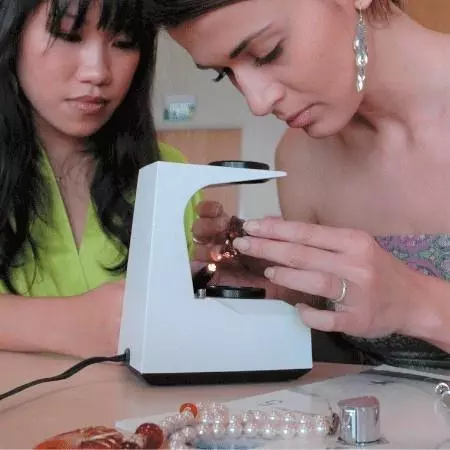
Polariscope
This is another tool that is often used in the earliest steps of the identification process. The polariscope assesses whether a gem is singly refractive or doubly refractive – from this, gemmologists are able to distinguish between gem types by quickly eliminating many options. As the function of the polariscope is dependent on observing the light that passes through the material, it can work only on transparent and translucent stones, and not opaque stones.

Dichroscope
The dichroscope also assesses double refraction in a gem and is a useful alternative when the polariscope cannot be used. It is helpful in separating glass and other cheap man-made imitations from natural gemstones that are doubly refractive.

Microscope
The microscope is used when higher magnification is needed to observe the inclusions in a gemstone. Observing specific types of inclusions can help gemmologists to distinguish natural, synthetic, and imitation gems. The microscope is also helpful in assessing all kinds of treatments and enhancements typically practiced today.

Spectrometer
Spectrometers allow gemmologists to observe the absorption spectra of gemstones and compare the patterns to those of known gems. The spectrometer can detect origins of chemical elements in gemstones, application of treatments and dyes, and other evidence that can help the gemmologist to distinguish between natural and synthetic materials.

Specific gravity liquids
These are chemicals with known specific gravity that gemmologists use to assess the density of gemstones. Every gem has a unique specific gravity – when an unknown gemstone is placed into a liquid of known density, the way it sinks, floats, or remains suspended indicates to the gemmologist its specific gravity, which then can be used to narrow down the possible identities for that gemstone.

Diamonds testers and screeners
Diamond testers and screeners are portable testing devices that function based on thermal and electrical conductivity and are a convenient way to separate diamonds from diamond simulants.
For a more detailed explanation on using diamond testers and screeners, join Tanja Sadow (Dean of JDMIS) and Armani Shariff (member of Presidium, leading manufacturer of gemmological instruments) in an informative video as they demonstrate testing on natural, synthetic, and imitation diamonds. (Watch the video)
While it may seem daunting at first to handle many types of professional and expensive gemmological equipment, the knowledge and skill of gem identification will be an invaluable addition to your repertoire, especially if you often need to handle gemstones in your gem trade or jewellery business.
Kickstart your journey to become a gemmologist with the Jewellery Design & Management International School (JDMIS), the only specialized jewellery training institution in Singapore. JDMIS’ gemmologist courses start you off with a strong foundation in the wide variety of gem materials available on the market and then delves deeper into gem identification as you learn how to properly use gemmological equipment to deduce the identity of gemstones.
Tanja M. Sadow G.J.G.
Dean and founder of the Jewellery Design and Management International School
Frequently asked questions
Can a gemmologist identify a gem just by looking at it?
No. Gems today come in so many colours and cuts that no single colour or cut identifies a stone. Professionals test physical and optical characteristics - chemical composition, crystal structure, refractive index, birefringence, specific gravity, pleochroism - and eliminate possibilities that do not match.
Why is the 10x loupe the standard gemmological tool?
The 10x loupe is the international standard for gem grading and evaluation - portable and useful for observing external characteristics and inclusions, which can sometimes distinguish natural gemstones from their imitation counterparts.
What does a refractometer measure?
A gemstone's refractive index - the speed and bending of light as it passes through the material. Since few gems share the exact same refractive index, it is one of the most straightforward and accurate tools for narrowing down identity.
Ready to go beyond home testing? The Gem Identification Methods course (GT200) teaches professional equipment and examination of 100 gems.
Gem notes: Garnet: a colourful history & fashionable future · Pearls: timeless elegance & fashionable statements.
Try it yourself: How to identify gemstones at home — a step-by-step practical guide.
For the full professional sequence — colour, refraction, RI, birefringence, pleochroism, UV and specific gravity with real values per stone — see How to Identify a Gemstone: Six Measurable Tests.
Keep reading: cabochon vs faceted cutting styles.
Explore further: play Name That Gem, a free gem-identification game, or trace gems to their sources on the Gem Globe.
No lab tools at hand? The gem reference has a plain-language guide to identifying gemstones at home with what you already have.
Related reading: cabochons and faceted gems, the two ways a stone is cut.
Identify a stone yourself
Work through the clues with JDMIS' free gem identification wizard, or look the material up in the gem materials index: 83 materials with hardness, refractive index, specific gravity and per-carat value ranges, each sourced to GIA and mindat.org.
Need a certificate in Singapore? Singapore gem labs guide or the Gem Identification Methods course.
Train with these tools at JDMIS
The professional gemmology pathway runs through two certificate courses: Gem and Jewellery Trade Secrets and Gem Identification Methods, where the loupe, refractometer and polariscope work you just read about is practised on natural, synthetic, imitation and treated stones.


A modern silversmith has more than one way to create stunning and saleable jewellery. What tools do you need and what learning path to take to become a successful silversmith? Today I will tell you how!

In this tutorial, we will walk you through how a filigree ring was made, from creating the structure of the ring from scratch, to making the filigree designs, and finally the setting of the Sapphire into the bezel.
Read more: Make a Silver Filigree Ring with Stone Setting step-by-step